

For You, Pastor
You’re Too Busy to Build This.
Good News: You Don’t Have To!
You already know the men in your church need real discipleship — not another event. What you almost certainly don’t have is the time to personally design, staff, and run that ministry on top of everything else on your plate. That’s not a character flaw. It’s simple math. And the research on what actually produces a healthy discipleship culture says the math was never supposed to work that way.
See What the research Says You Actually Need to Do
If your church has no discipleship plan for men, you’re in the majority, not the minority.
This isn’t a guilt trip. It’s a diagnosis… good news, because a diagnosis points to a fix.
You already know this. You feel it every time you look at the men’s ministry line on the budget and wonder who’s actually running it. The point isn’t that you’ve failed. It’s that, like nearly every pastor, you’re carrying a mandate (Matthew 28:19–20) without a system.
Only 52% of U.S. Protestant pastors have an intentional plan for discipling individuals in their congregations. Just 30% say their church has a specific method for measuring it. Only 8% are extremely satisfied with the discipleship happening in their church.1
When pastors rank their church’s six core functions, discipleship comes in last — only 11% say it’s their church’s strongest area. Corporate worship leads at 30%.2
Only 1% of church leaders say today’s churches are discipling new believers “very well.” 60% say “not too well.” Meanwhile 92% of congregants think their church is doing fine. Pastors already see the gap clearly — their people don’t.3
Two things predict a healthy discipleship culture. “Do it all yourself” isn’t one of them.
Barna studied churches recognized specifically for discipleship excellence — the exemplars — to find out what they actually had in common.
A healthy culture of discipleship is created by two things above all others: senior leadership vision or endorsement, and a clearly articulated plan. Roughly three-quarters of exemplar churches point to these two factors as critical.4
Churches with a dedicated discipleship leader consistently engage more of their congregation in spiritual growth — because the leadership isn’t trying to hold the whole thing up alone.5
Read that again: vision and endorsement. Not personal facilitation. Not another item on your calendar every Tuesday morning. The two things the healthiest churches share are things you can absolutely still give, busy as you are — a clear “yes, this matters, and I’m behind it,” and a plan that’s actually written down. What most churches are missing isn’t a willing pastor. It’s the plan.
We call it the On Target Institute.
What OTM asks of you:
- A short, personal endorsement, from the pulpit or in writing, that this ministry matters.
- Identifying 2-10 men you already trust to lead it
- A yearly slot on the calendar
- A few minutes to introduce it church-wide
- Periodic visibility: stopping by, praying over it, asking how it’s going.
What OTI equips you with:
- The Men On Target curriculum: 60 weeks of ready-to-use sessions
- Leader facilitation training that equips a Table Leader for each group of 5-8 men
- A proven weekly rhythm: a 15-minute message and a 45-minute discussion led by a Table Leader
- A model for weekly calls: Table Leaders checking in one-on-one with each man, actually building trust
- Ongoing coaching access to OTM leadership as questions come up
CTA BUTTON: See the Men On Target Curriculum
OTM supplies the curriculum.
Your church runs the meeting.
On Target Institute exists to be the second half of that Barna research – the clearly articulated plan – so you stay focused on the part only you can do: casting vision and putting your name behind it. This is never OTM running your ministry for you. It’s a ministry of your church, meeting in your building, led by your own men. We hand you the curriculum, the leader training, and 25 years of refinement across dozens of churches. Your leaders won’t building a program from scratch, they’re facilitating one that’s already proven.
Not Sure Who to Pick? Choosing Your Men’s Ministry Leader
Vince has always said a senior pastor needs to be “fully involved and in charge” of ministry to men — and that’s still true here. “In charge” means the vision and the buck stop with you: you say yes publicly, you pick the men who’ll lead it, and you stay visibly behind it. It has never meant you personally have to facilitate the Tuesday night discussion.
In a perfect world, you’d be the one leading this yourself, sitting at the table every week. If that’s ever realistic for you, it’s the strongest version of this ministry there is. But “ideal” and “available” aren’t the same thing — and this page exists for pastors living in the real world, not the perfect one. Vision, endorsement, and a plan are still enough to build something real.
Endorsed by John Maxwell, Jack Hayford, Dick Eastman, and Pat Boone. Dick Eastman, International President of Every Home for Christ, called Vince’s approach “among the finest I’ve ever seen for equipping and enabling mighty men of God.”
The men are already walking back through the door.
This is a strange and hopeful moment. After decades of decline, men are returning to church faster than women — and the youngest men are leading the trend.
As of 2025, 43% of men and 36% of women report attending church weekly — the largest gender gap Barna has recorded in 25 years of tracking, reversing decades of women outnumbering men. Gen Z men (46%) and Millennial men (55%) are driving it.6
42% of young men ages 18–29 now say religion is “very important” to them — a 14-point jump in just two years, and the highest level Gallup has recorded for young men in more than a quarter century.7
That national trend isn’t hypothetical — it’s already visible on the ground. One church in Colorado Springs started an OTI breakfast with 25 men. Three years later, roughly 400 men meet weekly across nearly 40 different churches in that same area. When the plan is already there, men show up.
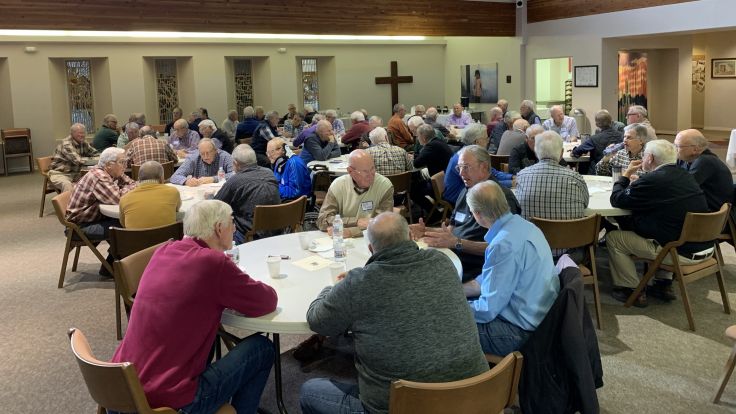
They’re coming back hungry for something real. The only open question is whether there’s a plan waiting for them when they arrive, or just another pancake breakfast.
This isn’t a request for another sermon series.
If the ask sounds like “add more content,” it’s reasonable to feel tired before you start. That’s not what this is.
Ask most pastors, off the record, and they’ll tell you the same thing: a sermon opens a door. It doesn’t keep a man walking through it on his own. The tool churches trust most has the lowest retention — and the tool that actually forms people, sustained small-group relationship, is used the least.8
OTI isn’t more preaching. It’s the small table, the 5–8 men who show up for each other every week for a real ~45-minute conversation, and the trained Table Leader who keeps it running — and who’s encouraged to call each man during the week just to check in, no agenda. That weekly, no-agenda call is where the real trust gets built. That’s the exact ingredient the research says is missing, not an extra sermon for you to write.
This isn’t just about your church. It’s about their kids, and the street they live on.
The men who show up at their table go home to kids, marriages, and neighborhoods. What happens — or doesn’t happen — in that hour a week doesn’t stay in the room.
Roughly 1 in 4 children in the U.S. grow up without a father in the home — the highest rate of any nation on earth, more than three times the global average.
A 40-year Oxford study of over 3,000 adults found that a warm, close relationship with a father was the single strongest predictor of whether that child practiced faith as an adult.
Every man who gets pulled into a real, weekly relationship at their table — not a lecture, an actual relationship — is a man who becomes more likely to be the present father his own kids need. That’s not a guess. It’s the same research, running in the direction you want it to.
OTI has saved my life and my faith. Since I joined, I’ve faced incredible trials — I lost my job, then two weeks later, on Father’s Day, I lost my best friend to cancer. Shortly after, my wife told me she wanted to separate, and my oldest son moved away. Through OTI I’ve come to understand that God is real, and that He walks through the pain of every circumstance with me.
J.J
MONUMENT, CO
You champion it. Your own leaders run it. OTM gives you the curriculum.
You don’t have to clear your calendar to fix this, and OTM isn’t asking to run your meeting for you. This stays a ministry of your church, led by your church’s own men, meeting in your own building. Your part is to make one decision, say one sentence to your congregation, and hand the plan to men you already trust. Their part is to facilitate it week to week using the Men On Target curriculum and the training that comes with it. OTM’s part is to have already built that plan, tested it for 25 years, and stay available for coaching along the way.
CTA BUTTON: Schedule a 20-Minute Strategy Call with Vince
CTA BUTTON: See the Full Curriculum Overview
Note: Keep this as a two-button close, not a form. A time-strapped pastor will take a 20-minute call before he’ll fill out a lead form. Route both buttons toward a real calendar link.
Sources
1: Barna Group, cited in His Call, Your Response, Chapter 9
2: Ibid.
3: Ibid.
4: Ibid., Chapter 19
5: Ibid.
6: Ibid., Chapter 6
7: Ibid.
8: Ibid., Chapter 9