

The Process
There’s a goal behind everything OTI does, a method that actually gets there, and a process any church can run.
OTI — the On Target Institute — is how On Target Ministries equips local churches to disciple men. We didn’t set out to run better men’s events. We built something different: a real answer to how men actually change. Here’s the goal, the method, and the process behind it.
The Goal
Scripture is direct about what the church is actually for: “for the equipping of the saints for the work of ministry” (Ephesians 4:12, NKJV). Not just informing them. Not just inspiring them for an hour on Sunday. Equipping them — building them into men who can actually do the work.
Ask most Christians, honestly, whether their church has equipped them like that, and the answer is usually no. That’s not a knock on any one pastor. It’s a structural gap in how most churches are built — and it’s the same gap Vince has spent years asking pastors to name directly: what’s your product?
Ask what Chrysler’s product is, and the answer comes fast: “cars.” But that’s not quite right — Chrysler’s real product is transportation. Cars are just how they deliver it.
Ask a pastor what the church’s product is, and the best answers usually land on “Christ-like people.” Closer — but still not quite it. The real product of a local church is a godly community, built one changed man at a time — men who are intimate with God, know their identity in Christ, and live out their destiny: the man God intended, a true Disciple. That’s what equipping actually looks like. Not attendance. Not another program on the calendar.
See the full breakdown of how that actually happens: The Model
The Method
We event men to death (a wedding is an event… not a marriage).
A conference. A retreat. A sermon series. A quarterly men’s breakfast — and then another one next quarter. None of that is wrong on its own. An event has a real job: it raises awareness. That’s all it can do. The mistake is treating awareness like it’s the finish line — scheduling the next event, and the next, hoping one of them will finally be the one that sticks. It won’t. It never has.
Real change happens in six stages: Event → Awareness → Decision → Commitment → Process → Change.
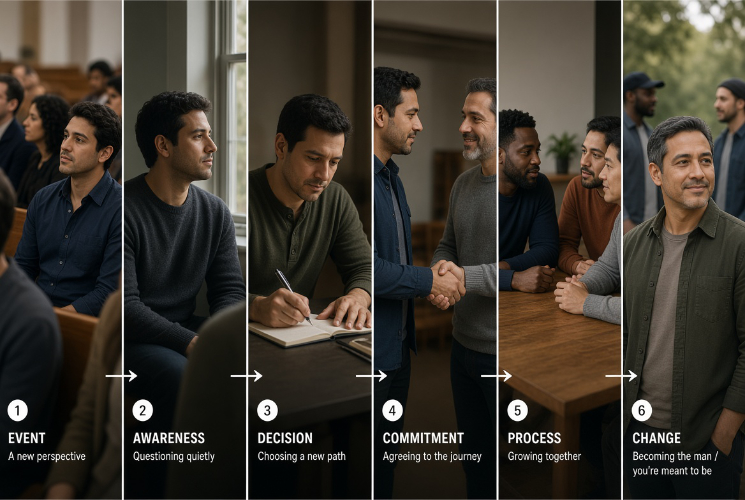
Most men get stuck in the first three — the cycle of hopelessness most of us live in without realizing it. An event raises awareness. Awareness leads to a decision. But a decision rarely survives contact with Monday morning on its own. The way out is commitment, followed by process — real behavioral change, worked out over time. That’s the stage most ministries skip, because it’s the hardest one to fit into a single event.
And process doesn’t happen alone in a room with a workbook. It has to happen in a relational environment — men known well enough by other men that there’s no room left to fake it. That’s why OTI doesn’t stop at commitment and hand a man a curriculum to work through by himself.
For decades, we’ve known that the definition of ministry is “setting an atmosphere for the Holy Spirit to work.” That’s what the relational environment is for. OTI doesn’t claim to change men — God does that. The table, the weekly rhythm, the trained Table Leader, and the midweek call all exist to set the atmosphere where He can.
Every week, men gather at an OTI breakfast — not a lecture hall, a table. Tables of 5 to 8 men, led by a trained Table Leader, work through the Men On Target curriculum: a short message — 12 to 15 minutes, max — followed by 45 minutes to an hour of real table discussion, in a meeting that runs about 75 to 90 minutes start to finish. Between meetings, every man gets a non-agenda check-in call from his Table Leader — not a reminder about next week, just someone asking how he’s actually doing.
The curriculum itself is built precept-upon-precept: 60 weeks of sessions that build on each other deliberately, the same way you wouldn’t teach calculus before arithmetic. It’s not a new topic every week for the sake of novelty — it’s a sequence, designed to move a man through the stages that actually produce change, inside a relationship that makes the process possible in the first place.
The Process
Here’s how it actually starts in a church — no new staff hire, no year of planning required:
- The pastor casts the vision. A short personal endorsement, from the pulpit or in writing. This works best with a pastor’s visible backing — though OTI also serves pastors for whom being the one at the table every week isn’t realistic right now.
- A Men’s Ministry Team gets identified. Two to ten trusted men the pastor already knows — not necessarily the loudest voices, the steady ones.
- OTI equips them. Table Leader training, the full Men On Target curriculum, and ongoing coaching access to OTI leadership — nobody’s building this from scratch.
- The weekly rhythm begins. One short message, real table discussion, one non-agenda call a week. That’s the whole structure — and it’s what sets the atmosphere.
- It grows on its own momentum. One church in Colorado Springs started with 25 men at a single breakfast table. Three years later, more than 400 men were meeting weekly, across roughly 40 churches. Nobody planned for 400 on day one — it started with a handful of men who kept showing up for each other.
Where You Fit
If you’re a pastor — see what OTM asks of you and what OTI equips you with.
If you lead — or want to lead — men’s ministry — here’s exactly how to start.
If you’re a man ready to start this yourself — here’s your first step.